Email capture with seller funded incentives — seller experience in SMA
To comply with my confidentiality agreement I have omitted and appropriated confidential information. These designs are a reinterpretation of the original.
Summary
While most participants easily understood how to enable the SFI email capture feature, they lacked confidence due to the absence of a settings confirmation or preview screen. Sellers were hesitant to enable the feature without the ability to customize or see the customer experience beforehand.
- Sellers need customization options for discount messaging to align with their brand and legal requirements.
- A preview screen and multi-step enablement process would build seller confidence and improve adoption.
- The current "Turn On" link lacks clarity — sellers expect a toggle or more intuitive UI.
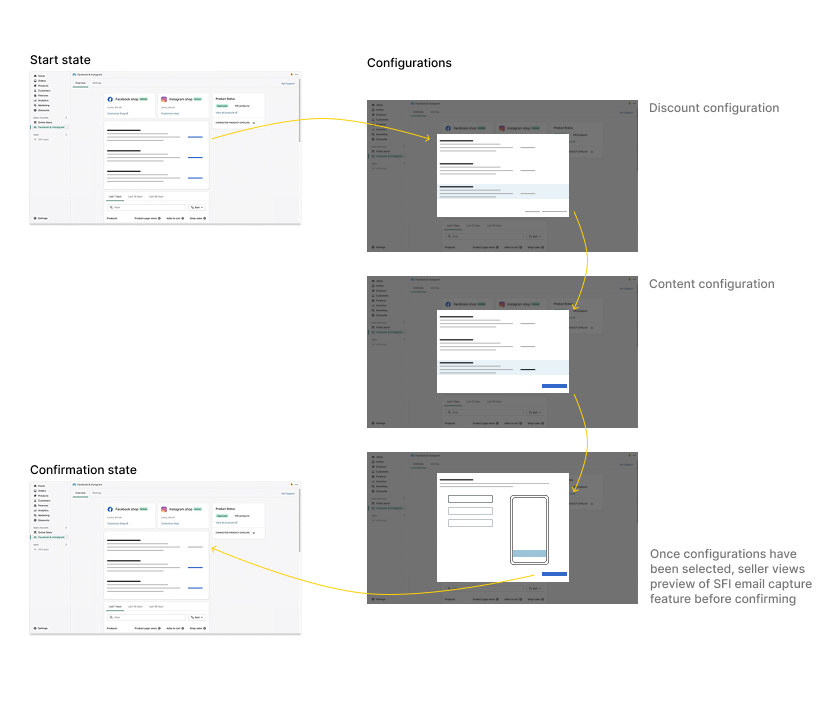
- Introduce a multi-step flow with settings and a preview before enabling the feature.
- Provide customization controls for discount amounts, messaging, and branding.
- Redesign the enablement interaction — replace "Turn On" with a toggle.
Outcomes
These changes are expected to increase adoption and satisfaction, driving incremental GMV growth and reducing seller churn across the Shops Ads ecosystem.
GMV growth
Incremental increase in Shops Ads GMV in H1 '23
Net churn rate
Reduction in seller churn with improved adoption
Context & Project Objective
Within SMA, there was no method for sellers to enable and configure Seller Funded Incentives (SFI) due to contractual and technical blockers of email capture between Shopify and SMA. As of February 2023, an agreement was reached to allow set-up and configuration of SFI email capture within SMA. This new feature is expected to increase seller adoption of incentives, improve Meta's price parity, and drive +0.63% incremental Shops Ads GMV.
Help sellers become aware of and adopt email opt-in with an incentive within SMA — enabling them to collect more customer email addresses, re-engage with buyers, and drive lifetime value.
Drive adoption of 1-click email capture SFI to improve promotional parity and protect Shops Ads performance as Meta reduces reliance on MFI. H1 goal: adoption with 1,700 TAM sellers (20% of Shops Ads revenue). H2 goal: expand to sellers representing 50% of Shops Ads revenue.
Understand key pathways for adoption and which surfaces to prioritize. Ensure the end-to-end flow is frictionless and sets clear seller expectations. Identify unmet needs most critical to sellers for product prioritization.
Research Goal: Maximize SFI Email Capture Adoption
The objective was to collect seller feedback on the design, content, and functionality of the SFI email capture feature to discover potential areas of improvement to maximize seller adoption on launch.
Ease of Use
Identify usability issues that might block or hinder seller adoption. Can sellers discover SFI email opt-in? Can they change the discount amount before and after enabling? Can they enable pre-select checkout opt-in?
Understanding
Determine how well sellers interpret and comprehend the feature, its language, how it works, what it impacts, and all functionality options available — including where discounts apply (checkout vs. storefront).
Satisfaction
Understand how well the SFI email opt-in feature meets sellers' needs. Does it meet their email capture needs? Is anything missing? Would they feel confident enabling it?
What we learned
Understanding & Usability
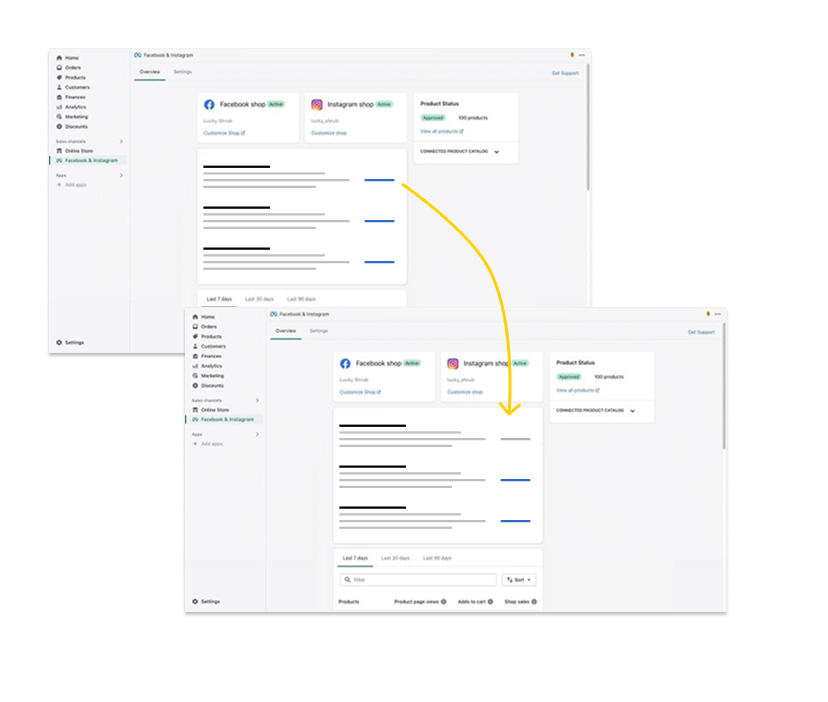
Most participants understood how to enable the feature via the "Turn On" link but hesitated to proceed due to a lack of confidence in the functionality. Sellers expected to be directed to a settings page or pop-up upon enabling the feature, where they could confirm, customize, and preview the customer experience before anything went live on their shop.
Customization Needs
Sellers expressed a strong desire for customization of discount messaging to align with their brand strategy and legal policies. For example, some sellers needed to frame email collection as offering value beyond discounts (e.g., exclusive notifications). Many felt the feature lacked flexibility for adjusting discount amounts or modifying opt-in messaging before enabling.
Content Clarity
While the feature description on the SMA home page was generally clear, some sellers were unsure where the discount originated or how it would apply (e.g., checkout vs. storefront/PDP). Misunderstandings arose about whether the discount was linked to Shopify or third-party email platforms like Klaviyo.
Expectations for Feedback & Control
Sellers expected more control over the activation process, including options for modifying discount amounts, customizing email messaging, and previewing the customer experience before enabling. Many expected a toggle or clearer UI elements rather than a plain "Turn On" text link to enable/disable the feature.
Concerns with 1-Click Enablement
The 1-click enablement process was seen as too rigid, which discouraged adoption. Sellers wanted a multi-step process for greater transparency and control — they didn't want a feature affecting their customer experience to go live without first reviewing what it would look like.
Recommendations
Rethink the 1-Click Option
All participants understood the feature, however sellers expected to configure and customize how email collection would appear on their shop surfaces. To facilitate adoption, create a multi-step enablement process that gives sellers control and feedback on discount amount, location, language, and branding — before anything goes live.

Alpha Launch Survey
The Alpha Launch survey includes a question about how well the feature meets sellers' needs. If this result is also low, it provides further evidence that sellers want more control and feedback on how the feature will be enabled — reinforcing the case for a redesigned multi-step flow before wider rollout.
Research Scope
Note: this scope was intentionally broad and adjusted depending on the best research collection opportunity given project timing.
Background Questions
General questions to understand how sellers currently capture email from buyers.
1-Click Opt-in Flow
What questions specific to this flow will impact the design and launch of this feature?
Settings / Multi-step Opt-in Flow
Follow-up Questions
Research & Data Collection Methods
Due to time constraints, three collection approaches were explored.
Shopify Rolling Research Program
A mid-April round of rolling research submitted for selection. If chosen, we could run concept and usability tests with up to 6 sellers — covering content, designs, and overall feature impression.
Alpha Launch Survey
A brief survey during the April 2023 Alpha Launch measuring perceived ease of use and satisfaction. Two questions calculate a Single Usability Metric (SUM), with high validity and correlation to SUS scoring.
UXR Usability Test & Interview
Moderated usability test (qual + quant) combined with deeper questions on email capture to fully understand seller goals, practices, and how our feature compares to their current methods.
Data Collection Goals
Behavioral metrics provide valuable insight into feature performance, but only answer 'what' users are doing. Compared to predefined success metrics, this may be sufficient data collection.
However, for a new feature — without existing benchmarks to judge success — qualitative research is essential to understand 'why' users behave in a particular way.
Both forms of data collection help develop a fuller understanding of how users interact with the feature and how it can be improved to meet their needs.